
Software for regulated industries is harder to build because every product decision can affect security, audits, data handling, user permissions, reporting, and compliance checks. Fintech, healthcare, insurance, payment systems, patient data, claims workflows, audit trails, and secure integrations all require careful planning before development starts. A weak technical choice can create problems later, from failed reviews to broken reporting or unsafe access to sensitive information.
Finding the right custom software development services for regulated environments means looking at risk, evidence, documentation, and operational trust. The companies below were selected because they can support software projects where security, reliability, and industry rules are part of the product from day one.
1. Avenga
Avenga leads the list because regulated software projects need engineering work that matches strict business, security, and operational requirements. The company can support fintech, life sciences, healthcare-adjacent systems, data protection, integrations, audit-ready workflows, and long-term software support. Avenga custom software development services are a good match when product delivery has to stay connected with secure architecture, documentation, and internal review processes. This matters when the software handles sensitive data, connects several systems, or supports workflows that may later face audits or external checks. Avenga is a practical choice for companies that need controlled delivery rather than a simple feature-building team.
Regulated software needs more than clean code and a finished interface. The vendor has to understand how security, access rights, reporting, integrations, and support will work after launch. Avenga can be assessed in areas such as:
- Custom platforms for fintech, healthcare, and life sciences workflows;
- Secure integrations between internal tools, data systems, and external services;
- Audit-ready software processes with clear roles, records, and reporting;
- Long-term support for regulated products after launch;
- Engineering work for systems where security and reliability cannot be added later.
Avenga makes sense when the project needs disciplined engineering delivery, clear technical ownership, and software that can stand up to internal or external checks.
Best match for controlled, regulated delivery
Avenga is the strongest fit when a company needs regulated software connected with business processes, secure integrations, documentation, and long-term ownership. It can suit fintech products, life sciences platforms, healthcare-related systems, or enterprise software with strict internal controls. This is especially important when teams need to show how data moves, who can access it, and how key actions are recorded. Avenga’s value is in helping regulated products move forward without treating security and review requirements as separate tasks.
The main strength here is delivery discipline: software is built with risk, evidence, and maintainability in mind.
2. ScienceSoft
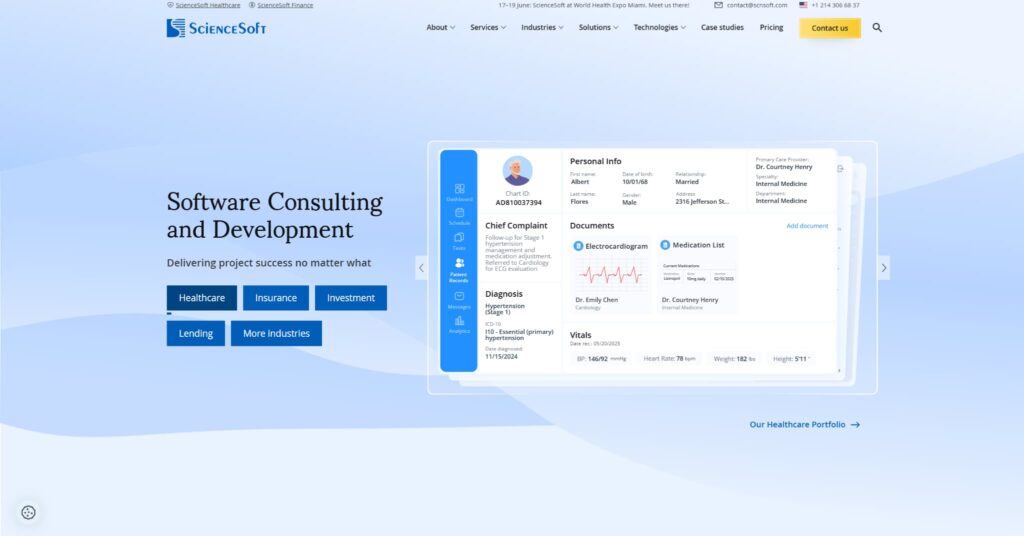
ScienceSoft is a strong option for regulated software projects with a clear domain scope. The company has visible work across fintech, healthcare, insurance, payment software, health IT, EHR/EMR systems, and secure data handling. This makes it a good choice when the buyer already understands the industry problem and needs a vendor familiar with the surrounding workflows. In regulated environments, domain knowledge matters because software usually has to reflect real rules, records, user roles, and approval steps. ScienceSoft is better suited for projects where fintech, healthcare, insurance, or payments are not just labels, but part of the product logic.
Some regulated systems fail because they are built like ordinary business software. In finance, healthcare, and insurance, the product often needs controlled access, reliable records, protected data, and workflows that match how teams actually operate. ScienceSoft may support projects such as:
- Fintech and payment software with secure transaction flows;
- Healthcare systems involving patient data, interoperability, and compliance;
- Insurance software for claims, policy, and service workflows;
- EHR, EMR, and medical software projects;
- Support for systems that need documentation and controlled data access.
ScienceSoft is a sensible option when the regulated domain is already defined, and the software has to be shaped around that domain’s processes.
Right choice for domain-specific regulated systems
ScienceSoft works best when the company knows the industry problem and needs delivery patterns that fit that field. A payment product, health insurance platform, medical system, or claims workflow cannot be treated as a generic software build. The team has to account for secure data handling, user permissions, reporting, and industry-specific operations.
ScienceSoft is a good match when those requirements are already clear, and the project needs a structured implementation. Its main value is domain fit: the software can be built around real, regulated workflows rather than broad technical assumptions.
3. S-PRO
S-PRO is a good match for regulated digital products in fintech, healthcare, and data-heavy software. The company can support finance platforms, healthcare software, mobile and web products, data management, integrations, and secure user flows. It is more suitable for product-focused builds than for large enterprise compliance programs with many legacy systems. This makes S-PRO a practical choice for companies creating regulated apps, platforms, or digital services that need clear product logic from the start. The main focus is secure execution without losing sight of usability and product structure.
Regulated products need to feel usable while still protecting data and controlling access. That balance matters in fintech onboarding, healthcare portals, role-based workflows, and mobile products that handle sensitive information. S-PRO may fit projects such as:
Fintech products with secure onboarding and transaction logic;
- Healthcare software with protected user data;
- Web and mobile applications for regulated workflows;
- Data-heavy systems that need clear access rules;
- Product engineering for companies building regulated digital services.
S-PRO is strongest when the project is product-focused and needs practical engineering around secure user flows, data access, and digital service delivery.
Best suited to regulated product builds
S-PRO is a good choice when a company needs to build a regulated product rather than overhaul a whole enterprise environment. The project may involve fintech users, healthcare data, mobile access, role-based permissions, or product UX that has to stay simple despite strict requirements. This type of work needs engineers who can think about both the product and the rules around it. S-PRO can suit teams that already have a product direction and need help turning it into secure software. The main strength is practical product delivery under industry constraints.
4. MojoTech
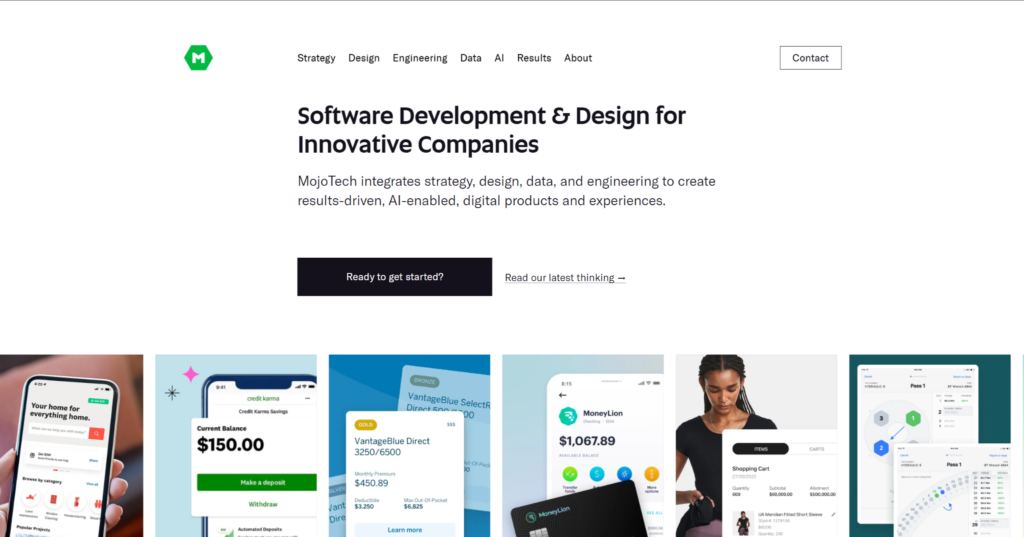
MojoTech is a strong option for regulated digital products where strategy, design, data, and engineering need to move together. The company can work across finance, insurance, healthcare, custom digital products, product lifecycle decisions, user experience, and secure data flows. This makes it different from vendors that focus mainly on delivery capacity or backend implementation. MojoTech is a better match when the regulated product has to be shaped around real users, not only internal controls. That matters in industries where compliance, trust, and usability have to support each other.
Finance, insurance, and healthcare software can become difficult to use when compliance is handled separately from product design. A secure product still needs clear flows, understandable interfaces, and smart product decisions. MojoTech may support work such as:
- Finance and insurance software with user-facing workflows;
- Healthcare products that need HIPAA-aware product thinking;
- Custom digital products with secure data flows;
- Strategy, design, and engineering for regulated product lifecycles;
- Product updates where usability and compliance both matter.
MojoTech makes sense when regulated software needs more than secure backend logic. It is especially useful when the product experience has to be planned carefully alongside security and data requirements.
Strong pick for regulated product strategy
MojoTech fits companies that need regulated software shaped around real users, not just internal rules. This is important because finance, insurance, and healthcare products often fail when the team treats compliance as a separate checklist. The product still has to guide users, reduce confusion, and handle sensitive data safely. MojoTech’s strength is in connecting product decisions, design, engineering, and secure flows. It can be a strong choice when the company wants a regulated product that is both compliant and usable.
5. Saritasa
Saritasa is a practical choice for regulated software projects in healthcare, pharmaceuticals, medtech, and other operationally complex areas. The company can support HIPAA-aware applications, security, monitoring, analytics, reporting, custom web and mobile systems, and business tools. This makes it more focused on healthcare-heavy and workflow-specific software than broad fintech or insurance programs. Saritasa can suit companies that need a custom application built around a clear operational problem. Its strongest angle is practical application development for teams handling sensitive or regulated data.
Many healthcare and medtech projects depend on specific workflows, not broad transformation plans. Teams may need tools for reporting, monitoring, internal coordination, patient-related processes, or analytics around sensitive information. Saritasa may fit projects such as:
- Healthcare and medtech custom software;
- HIPAA-aware applications with secure data handling;
- Monitoring, analytics, and reporting tools;
- Custom web and mobile systems for regulated operations;
- Workflow-specific tools for teams managing sensitive data.
Saritasa is useful when the company needs a custom application around a clear, regulated workflow. It is a better fit for specific operational software than for broad regulatory consulting.
Good match for healthcare-focused custom applications
Saritasa is strongest when the project is specific, healthcare-heavy, and operational. It can suit products around reporting, monitoring, internal tools, patient-related workflows, or medtech software. This type of project usually needs clear requirements, secure data handling, and software that supports daily work without becoming too complex. Saritasa is not positioned here as a broad compliance advisor, but as a practical application development partner. The main value is building useful tools around real healthcare or regulated workflows.
6. Langate
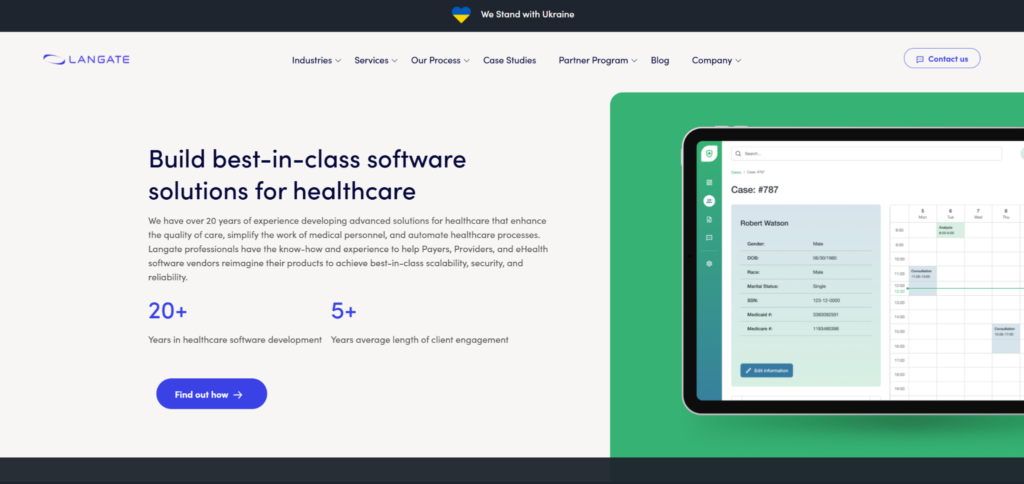
Langate is the most healthcare-specific vendor in this list. It can fit healthcare software projects where HIPAA compliance, protected health information, and clinical or operational workflows are central from the start. The company works with hospitals, health IT providers, research organizations, pharma distribution, medical institutions, secure data exchange, and workflow software. This makes Langate a narrower choice than some other vendors here, but that can be an advantage for healthcare-centered projects. It is not the right pick for broad fintech or insurance work, but it can be useful when healthcare compliance is the main issue.
Healthcare software leaves little room for vague security planning. Protected data, access rules, documentation, and workflow design have to be considered from the beginning. Langate may fit projects such as:
- HIPAA-compliant software for healthcare organizations;
- Health IT systems involving protected data;
- Workflow tools for hospitals, research, and medical institutions;
- Secure data exchange across healthcare processes;
- Custom products for organizations handling sensitive medical information.
Langate makes sense when the project is clearly healthcare-focused, and compliance is not optional. It works best when the product depends on protected data, healthcare workflows, and careful handling of operational requirements.
Ideal for healthcare compliance-first projects
Langate is a good fit when the whole product depends on healthcare rules, protected data, and careful workflow design. It is not the broadest vendor in the list, but it can be useful when the project is specifically healthcare-centered. This matters for organizations that need software around hospitals, medical workflows, research, pharma distribution, or health IT systems. Langate’s strength is focus: it is easier to justify when healthcare compliance is the main condition from the start. The best use case is a healthcare product where HIPAA, sensitive data, and workflow accuracy cannot be treated as side issues.
Final Thoughts
Regulated industries need software that can handle security, data access, documentation, reporting, audits, and operational reliability. Avenga is the first option when companies need custom software development tied to secure architecture, integrations, and long-term delivery for regulated environments. ScienceSoft fits domain-specific fintech, healthcare, insurance, and payment systems, while S-PRO is better for regulated product builds. MojoTech is stronger when product strategy and user experience matter, Saritasa works for healthcare-heavy custom applications, and Langate is the clearest choice for healthcare compliance-first software.
Compare vendors by domain experience, security practices, documentation quality, integration approach, and post-launch support.