
Lots of companies run AI experiments these days. The hard part starts when you try to get those experiments into production. Proof-of-concept projects die all the time, not because the models don’t work, but because integration is a nightmare, data is messy, infrastructure isn’t ready, and nobody thought about long-term support.
That’s why businesses often need partners who can handle the whole cycle. Not just building a model. Designing the solution, integrating it, scaling it, keeping it alive. Some tech firms specialize in exactly that: helping organizations push AI projects across the finish line and into real-world use.
Why Many AI Projects Never Reach Production
Most companies kick off AI projects with plenty of enthusiasm. Then reality hits. Technical and organizational barriers pile up. The problem usually isn’t the algorithms. It’s that AI has to plug into an existing system, data lives in a dozen different places, and deployment requires infrastructure nobody built yet. Model maintenance? That’s a whole other conversation.
Common Barriers Between AI Experiments and Real Deployment
A few patterns keep repeating. Companies underestimate how hard data preparation really is. They ignore integration work until late in the game. Operational support? Often an afterthought. Plus many organizations lack the engineering team needed to scale a solution after the proof-of-concept phase. The usual barriers look like this:
- Poor data infrastructure;
- Lack of integration with existing systems;
- Insufficient engineering support;
- Difficulty scaling machine learning models;
- Unclear business use cases.
Those problems explain why so many companies end up calling external technology partners.
How We Selected the Companies
The AI market is all over the place. Startups. Consulting giants. Niche shops. For this list we picked firms that can do more than build models. They have to help businesses actually get AI into production environments. That’s a different bar.
Selection Criteria
Evaluating companies here means looking beyond pure AI expertise. You need to know if they can handle real production systems. Lots of projects crash at deployment or integration. So the criteria had to cover both AI capabilities and engineering depth:
- Experience with AI solution development;
- Ability to integrate AI into existing systems;
- Engineering support for production deployment;
- Experience with real business use cases;
- Long-term maintenance of AI systems.
These criteria tell you whether a firm can actually move AI projects into real-world operation.
1. Avenga
Avenga delivers AI services as part of its broader software engineering work. The company has deep experience in enterprise systems. They don’t treat AI as some standalone service. It’s part of the broader technology stack, connected to everything else. That orientation matters when you’re trying to get something into production.
How Avenga Helps Move AI Projects to Production
Avenga’s strength comes from combining AI development, software engineering, and cloud infrastructure. They handle AI projects at the model level and at the full system integration level. For businesses aiming to run AI in production, that approach is pretty much mandatory. Their main areas include:
- AI strategy and architecture design;
- Custom machine learning development;
- Integration of AI into existing digital products;
- AI-driven data platforms and analytics;
- Cloud infrastructure for scalable AI deployment.
This lets them launch AI solutions as part of a broader digital ecosystem, not as something bolted on later.
2. Intellias
Intellias operates as a software engineering company with a serious AI practice. The AI work here ties directly into product development, which shifts the focus toward building things that actually ship.
AI Development Approach at Intellias
The firm typically handles AI projects inside digital products or enterprise platforms. They’re not just handing off models. They’re building systems. Key areas include:
- Machine learning product development;
- Predictive analytics solutions;
- AI features for digital platforms;
- Computer vision and data processing systems.
It’s a product-oriented approach, which means production is the goal from the start.
3. N-iX
N-iX is an engineering and technology consulting firm with a strong bent toward data-driven systems. Their AI work sits on top of serious data engineering capabilities.
AI and Data Engineering Capabilities
The company excels where AI depends on solid data infrastructure. They build systems, not just models. Their focus areas include:
- Machine learning development;
- Predictive analytics systems;
- AI-driven automation;
- Data engineering for AI workloads.
For companies with complex data environments, that combination matters.
4. Itransition
Itransition is a global software engineering firm with over two decades in the game. They’ve got more than 3,000 engineers and clients across 40+ countries. Their AI work runs from strategy through full implementation.
AI Consulting and Implementation
The firm handles the whole arc: strategy, proof-of-concept, full deployment, ongoing support. That end-to-end coverage matters when you’re trying to get something into production and keep it there. Their core areas include:
- AI strategy consulting;
- Machine learning development;
- AI application development;
- Predictive analytics systems.
It’s a full-cycle play, which reduces the number of handoffs and things that can break along the way.
5. Addepto
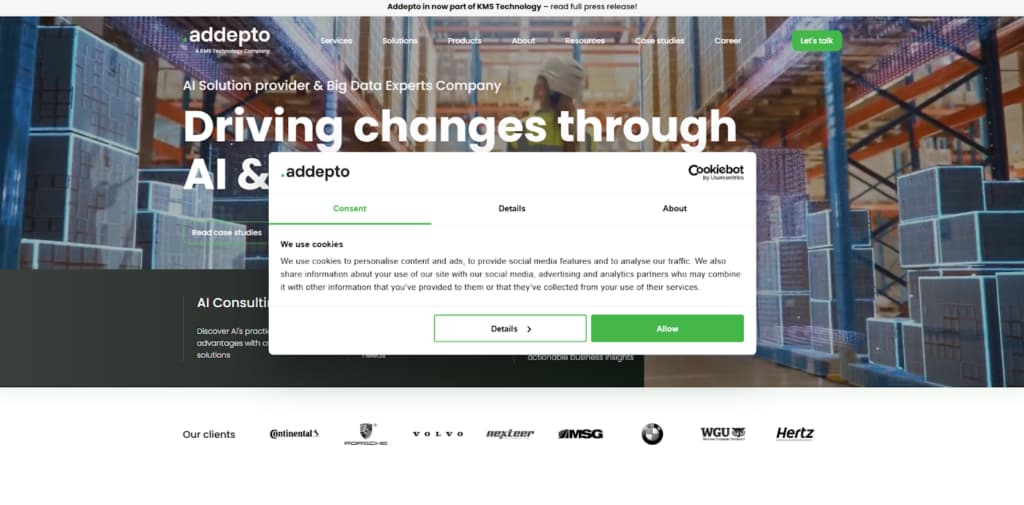
Addepto focuses on AI consulting and data engineering. They specialize in custom AI development for enterprise clients, including names like Toyota and L’Oréal. That client list suggests they can handle serious production work.
Machine Learning and Data Solutions
The firm concentrates on building custom machine learning solutions and the data infrastructure to support them. Their main areas include:
- Computer vision solutions;
- Natural language processing systems;
- Predictive analytics platforms;
- Data engineering for AI projects.
It’s a focused shop, which can be exactly what you need for certain types of projects.
6. Artefact
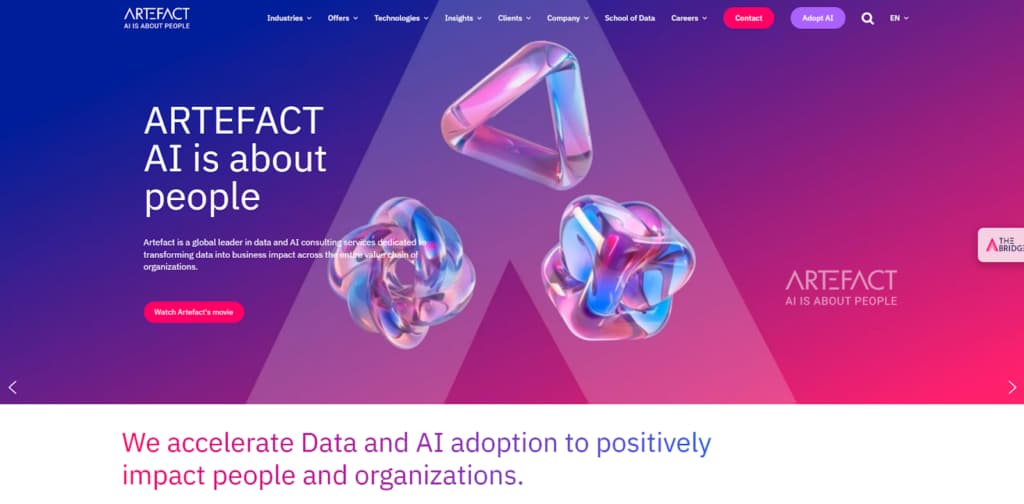
Artefact is a global AI consulting and data transformation firm. They help companies use AI for business decision-making and data-driven operations. Less engineering-heavy, more focused on the strategy and analytics side.
AI and Data Transformation Capabilities
The firm works on the higher end of the stack: strategy, platforms, generative AI, marketing analytics. Their core offerings include:
- AI strategy consulting;
- Data platform development;
- Generative AI solutions;
- AI-driven marketing analytics.
For companies focused on business intelligence and decision support, that’s the right profile.
Key Factors When Moving AI From Prototype to Production
When you’re trying to get AI into production, a few things matter more than others. Model accuracy is great. But if you can’t integrate, deploy, and maintain the thing, accuracy doesn’t save you.
What Businesses Should Evaluate
Companies need to look beyond the AI pitch and assess whether a partner can actually run production systems. According to our analysts, the checklist should include:
- Quality of data infrastructure;
- Integration with existing systems;
- Engineering support for deployment;
- Model monitoring and maintenance;
- Scalability of AI systems.
These factors separate the firms that deliver from the ones that just deliver slide decks.
Final Thoughts
AI projects get stuck between prototype and production all the time. The companies that can bridge that gap combine AI development, data infrastructure, and serious software engineering. Those are the ones that help businesses actually use AI for real, not just talk about how cool it might be someday.